Maryland EMTOC set to open in 2025, largest US transit depot microgrid
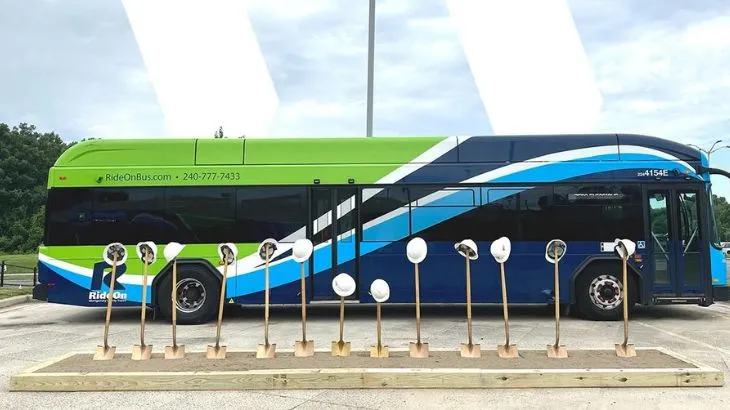 Image credit: WSP
Construction has started on Maryland’s David F. Bone Equipment Maintenance and Transit Operation Center (EMTOC), an integrated microgrid infrastructure project that will be the largest renewable energy-powered transit depot microgrid in the U.S., as well as the first on the East Coast to produce sustainable hydrogen energy on-site.
Montgomery County’s EMTOC is a major depot within Ride-On Montgomery’s network and the fifth largest county-owned energy consumer. By 2035, EMTOC is projected to accommodate 200 zero-emissions buses, mostly hydrogen fuel cell electric buses (FCEBs). It will feature electric bus charging and on-site hydrogen production powered by solar and battery energy storage.
Construction is expected to be completed by the end of 2025, when the system will begin sending renewable energy back to the grid and powering zero-emissions buses. The existing EMTOC depot will remain fully operational throughout its construction process, with no impact on transit services. The microgrid will also provide power to the local Pepco utility company and ensure uninterrupted service during extended grid or power outages and emergency situations.
WSP is contracted by M.A. Mortenson Co. as engineer of record on the design-build team. In turn, Mortenson is contracted by AlphaStruxure, the developer and leader in energy as a service (EaaS) microgrid solutions and a joint venture of Carlyle and Schneider Electric to deliver the EMTOC microgrid to Montgomery County, which operates the second-largest bus fleet in the Washington, D.C. region.
AlphaStruxure’s partners for the EMTOC project include Schneider Electric for the battery energy storage system, microgrid controls, switchgear and services; AZZO for network and cybersecurity; The Mobility House for charge management software; and Heliox for EV charger hardware. Trillium is providing the hydrogen electrolyzer system directly to the County.
WSP is responsible for all engineering design and deliverables, including photovoltaic modeling and collection, electrical infrastructure design, microgrid modeling, site civil planning with a heavy focus on permitting and storm water prevention and utility interconnection coordination.
Source: WSP