Utah DOT crews use ultrasonic testing methods on Salt Lake County bridge
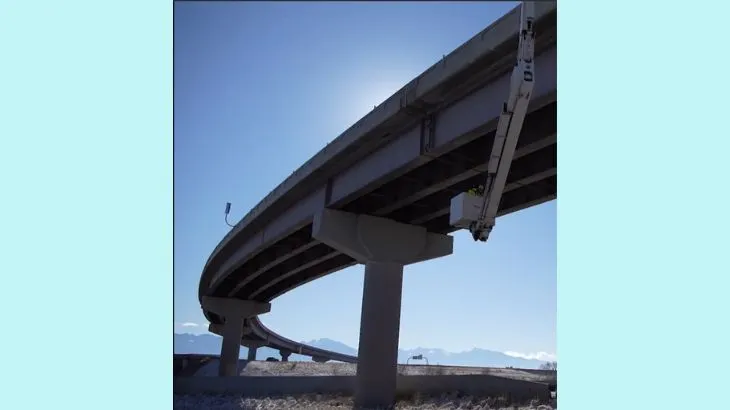 Image credit: UDOT
Utah Department of Transportation (UDOT) crews have inspected one of Salt Lake’s “Spaghetti Bowl” bridges with ultrasonic testing. This technology uses a transducer to transmit high frequency sound waves into difficult-to-see parts of a bridge, searching for damage, deterioration or any other factors that may raise safety concerns.
The bridge, built in 1985, connects northbound I-215 to westbound I-80.
Although not part of the standard inspection process, ultrasonic testing is used in specialty situations to evaluate critical bridge elements. The typical bridge inspection process involves detailed data collection, including written and photo documentation, and ranking scales. Occasionally, inspection crews use ultrasonic testing, LiDAR (eye-safe laser beams), ground penetrating radar, or infrared thermography to gather data on a bridge’s condition.
All inspection standards are set and evaluated by the American Association of State Highway and Transportation Officials (AASHTO) and the Federal Highway Administration (FHWA). UDOT bridge inspection crews use these standards to perform biennial inspections of more than 3,000 state and locally owned bridges, completing 150-160 bridge inspections per month.
Source: UDOT