IndyGo prepares to curb fare evasion, begins tap to pay with Masabi
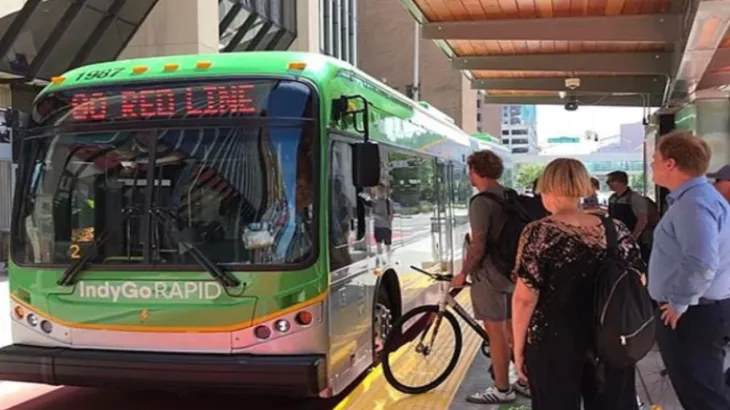 Image credit: IndyGo
IndyGo will soon move all its ticket scanners onto buses to reduce fare evasion and allow riders to simply tap their credit cards to board, as the transit agency shifts to a new payment system.
IndyGo will shift from MyKey to MyKey+ starting July 1, meaning riders should use up any remaining dollars this month. IndyGo will stop accepting new additions to MyKey accounts Aug. 1, and buses will no longer accept that money starting Sept. 1.
One big change will affect riders of the city's two bus rapid transit routes, the Red and Purple lines. Instead of scanning tickets on the boarding platform, riders will pay at one of three ticket validators inside the bus as they board. The goal is to cut down on fare evasion, or boarding the BRT lines without paying, IndyGo Chief Public Affairs Officer Carrie Black told IndyStar. Ticket scanners were built on the waiting platforms to keep buses moving quickly, Black said, but the tradeoff was that people could easily ride for free.
"One of the things that we know to be true with the off-board fare payment is that fare evasion went up," Black said. "This was an excellent opportunity to pivot away from the off-board payment, and put those [ticket] validators on the BRT buses so that we can have better oversight of our riders and the payment process."
IndyGo will continue to assign fare inspectors to ride the Red and Purple lines at random to verify that riders have paid, Black said. On other buses, people already must pay as they board.
Another major upgrade affecting all riders will come in late 2026, when ticket scanners include a tap-to-pay option that allows people to use credit cards and digital wallets if they don't have cash or MyKey+ money. Tap-to-pay has been available for years in major cities like Chicago and New York, allowing infrequent riders or out-of-town visitors to make use of public transit without loading money into unique payment systems. IndyGo expects riders will be able to tap and ride by November or December of this year, after it irons out any wrinkles with the transition to MyKey+.
The changes come as IndyGo transitions to a nearly $2.2 million three-year contract beginning next month with a British technology firm called Masabi, which works with transit systems in cities worldwide including Cincinnati, New York, Calgary and Madrid.
Other changes in the new system include the ability to link multiple family members to one MyKey+ account and buy more than one ticket at a time, in situations where riders may want to pay for friends or family. Frequent riders can save money on MyKey+ through fare capping. Starting July 1, riders can download the app or register on IndyGo's website, at the transit center or by calling IndyGo. Starting Aug. 1, riders will no longer be able to add money to ticket cards at IndyGo kiosks, but they can now do so during checkout at a network of more than 100 stores. They can also add money online or at the Julia Carson Transit Center service desk.
What won't change are the 57% fare hikes that took effect Jan. 1 for most riders, as well as the similar increases that will kick in July 1 for IndyGo Access riders with disabilities. The typical bus fare increased to $2.75 per two-hour trip. The one-day fare maximum for MyKey+ users will remain at $6, with the one-week limit at $24.75.
Source: IndyGo