Progress on King County Metro RapidRide R Line advances with three new strategies
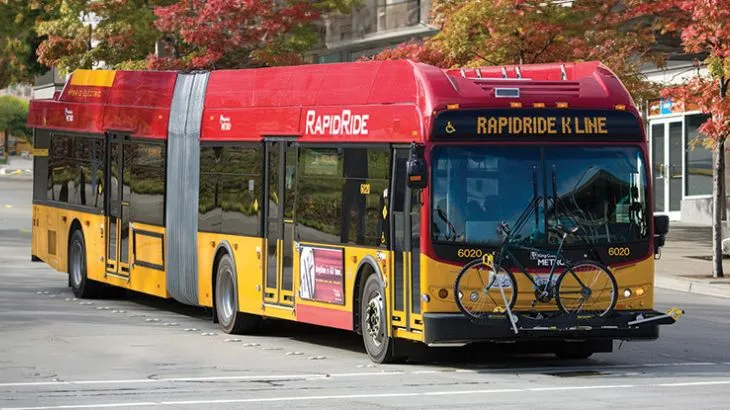 Image credit: King County Metro
Three strategies are being advanced to support the expedited delivery of the King County Metro RapidRide R Line. The line seeks to deliver more reliable transit, safer access to bus stops and better connections across South Seattle. The proposal adds stops in response to community concerns, with further opportunities for residents to shape the route and proposal during Council review and beyond.
King County Executive Girmay Zahilay announced three steps to advance the long-awaited RapidRide R Line: proposing $64.4 million in accelerated funding, sending a proposed route and station plan to the King County Council, and moving forward with the project’s design. The project aims to provide faster, more reliable transit in neighborhoods from Downtown Seattle, Chinatown-International District, Mount Baker, Columbia City, Hillman City, Brighton, Dunlap, Rainier Valley and Rainier Beach, Wash.
The project has been in development since 2015. The RapidRide R Line will upgrade King County Metro’s Route 7, with faster and more reliable buses and a new connection to the Rainier Beach Station. In addition to more reliable and frequent service, the project seeks to bring an investment in the everyday experience of taking transit in South Seattle: more dependable trips, safer ways to reach the bus and brighter, more comfortable places to wait.
Planned improvements include upgraded shelters and seating, better lighting, improved sidewalks and curb ramps, signs with real-time arrival information, expanded bus-only lanes to reduce traffic delays and boarding improvements to make getting on and off easier for people using wheelchairs and other mobility aids.
The following three strategies are being advanced:
Accelerated funding: In Executive Zahilay’s second omnibus budget proposal, he advanced $64.4 million to expedite delivery of RapidRide R. The goal in accelerating this funding is to build a strong partnership with the Seattle Department of Transportation (SDOT) and bolster our shared commitment to transit improvements for South Seattle.
Transmitting proposed alignment ordinance: Following extensive community engagement, Executive Zahilay has transmitted the ordinance to the King County Council, establishing general station locations for the future RapidRide R Line. Approval of this proposed legislation will allow King County Metro to continue design and delivery of RapidRide infrastructure and facilities along the corridor in preparation for planned service by 2032.
The proposed line will have a total of 58 individual stops along the route. Based on community input, two stops have since been added to previous designs at Rainier Avenue South at State Street and South Grand Street and Rainier Ave South at South Bayview Street.
In an effort to provide more reliable and faster service, the RapidRide R would not stop at 16 of the stops along the route that are currently served by the Route 7, as 12 of these would still be bus stops served by other bus routes, including routes 9, 14, 50, 106 and 547. The remaining four stops would be within 0.2 miles of a RapidRide R stop. Other stops south of Henderson Street that are served by Route 7 would not be served by the RapidRide R but will be addressed through a separate service-planning process described below.
Releasing request for proposal (RFP) for project to begin design: The project is at 10 percent design. The county and King County Metro report they have worked with the county procurement office to expedite publishing a RFP for engineering, planning and design services for RapidRide R to move design forward in partnership with community. Proposals are due by Nov. 5, 2026.
King County Metro is evaluating how to maintain strong and convenient transit connections for people traveling to and from areas south of South Henderson Street that will not be directly served by RapidRide R Line. Before the RapidRide R Line launches, King County Metro will engage communities south of South Henderson Street to better understand local travel needs, priorities and important destinations and connections.
Source: King County Metro