Leading with Purpose: Transforming RTD and Empowering Women in Transit
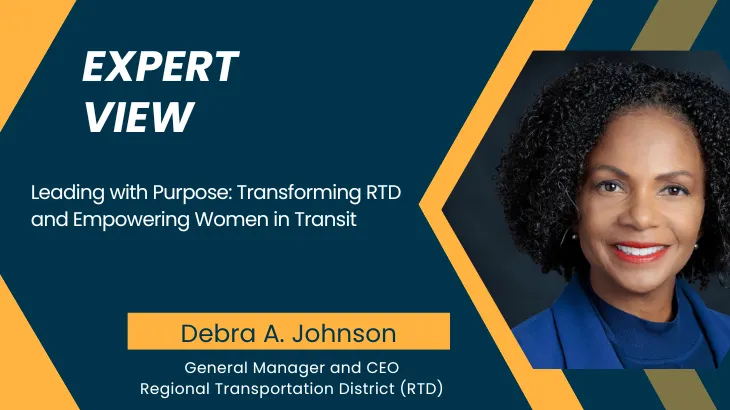 Image credit: TAM America
TAM America had the privilege of conducting an interview with Debra A. Johnson, General Manager and CEO, Regional Transportation District (RTD), and is pleased to share her leadership approach and vision in positioning RTD for success with customers, employees and local communities.
Please tell us about your leadership role at RTD and how your rich experience in leading some of the largest transit agencies led you to this role. What is your message for women in the transit industry?
As General Manager and Chief Executive Officer of the Regional Transportation District, I have the privilege of leading a dedicated, talented and hardworking team of more than 3,000 employees. RTD is the only multimodal transit agency in the state of Colorado, with bus, rail, microtransit and paratransit services, and it serves a growing population of more than 3 million people in the metropolitan Denver region. The agency encompasses a service area of 2,345 square miles and traverses 40 municipalities in all or part of eight counties.
I have had the opportunity to work at seven different public transit agencies across this country. I started my career in the San Francisco Bay Area, working at a consulting firm on a major interstate project with the California Department of Transportation (Caltrans). I have held executive positions at some of the largest agencies in the United States, including the Los Angeles County Metropolitan Transportation Authority (LA Metro), the San Francisco Municipal Transportation Agency (SFMTA) and Washington Metropolitan Area Transit Authority (WMATA). I have served as Deputy CEO of Long Beach Transit and was selected to lead RTD in August 2020. I joined the agency at the height of the COVID-19 pandemic.
As it relates to my core decision-making, it’s critical for me to be empathetic to other people’s pain points. I have to understand what is impacting the end user. And in doing that, I have to be highly communicative, I have to engage, and I have to be willing to lean in and listen. I have two ears – it’s important to me to listen more than I speak and not rush to judgment. I pride myself on being intentional and purposeful. I also look at data as well. It’s important to me that my decisions are based in fact, because oftentimes there are a lot of different ancillary factors that come into play. If I can balance the two, then I’m doing a good thing.
One thing that’s especially important to me as I reflect over the past three decades is that I have to show up and be my true, authentic self. We are providing a public service, and as it relates to the public transit sector, oftentimes women are not the ones leading organizations. When you look at transit agencies across the country, there typically aren’t women – let alone, women of color – in leadership spaces. Most recently, a study done by the Mineta Transportation Institute at San Jose State University observed that people of color and women are typically in lower-level positions versus the C-suite. When individuals think of a leader, they often assume it’s a man.
As relates to what I would say to women in the transit industry, speaking from my own experience: I know that I can be the voice of the voiceless and take the voice from the bus stop into the boardroom. I can make a true impact by standing in my truth for the betterment of those that I serve. And so can each of you, recognizing that each of us has a role to play. I often tell the team, we’re very analogous to a jigsaw puzzle: While that box may contain various shapes and sizes of puzzle pieces, if one piece of that puzzle is missing, that box-top cover will never be realized.
I encourage women to seek not just mentorship, but sponsorship as well. Both are critically important, and they go hand in hand. Being a mentor is providing an individual with support, helping them cultivate their trajectory, being able to be a thought partner. Sponsorship is basically advocating for someone when they’re not in the room. No one gets to where they are alone. Recognizing that is greatly important for one’s acceleration in a certain field. And another element I would add is that it’s important to have a coach. Simone Biles didn’t earn her first gold medal and then stop and say, I don’t need a coach anymore. We want to ensure that we stay at the top of our game.
Congratulations on RTD being ranked one of “America’s Best Midsize Employers” by Forbes! What have been some of your best practices in ensuring this success?
RTD is committed to providing competitive compensation and benefits to eligible employees that reflect RTD’s commitment to financial stewardship of taxpayer dollars. I engaged a market-based analysis of all non-represented salaries and took appropriate action to ensure that RTD can compete for and retain talent.
In October 2023, RTD introduced a comprehensive Manager and Supervisor Training program. Over the course of seven months, nearly 500 employees in these roles completed 24 hours of training across six asynchronous modules: Growing your Leadership Skills, Getting the Most Out of Your Team, Being an Effective Leader (in two parts), Employee Ownership and Pulling it all Together. It was important to me that core sets of training be developed for all employees, and RTD’s Development and Training Manager and I agreed that managers and supervisors would serve as a good starting point for this information. We recognized that participants came to training with differing roles, lengths of tenure and experiences at RTD, and the training ensured that managers and supervisors received uniform information around expectations for these positions, including how to take ownership, support team members and lead a team.
The agency’s internal communication strategy has been refined and enhanced over the last year to ensure that RTD’s workforce is engaged and informed. Tactics include regular periodic “Dialogue with Debra” all-employee meetings, as well as the launch of RTD’s weekly employee newsletter, Inside Connections, in digital form. This publication features staff accomplishments, important agency updates, retirement and new hire announcements, and a well-read Employee Spotlight section that includes recognition from peers and customers. This item and the Hot Sheet, a weekly roundup of important updates, are sent to all RTD employee email addresses. Division managers and administrative staff supports ensure that information is posted at operating divisions in locations where staff will see it. In September 2024, news and resources were made available to all employees through The RTD Bulletin, a link aggregator accessible via QR code and desktop.
How is RTD advancing the 2021-2026 Strategic Plan? What are your current priorities and plans for the future?
The 2021-26 Strategic Plan is RTD’s north star, and its four Strategic Priorities serve as functional pillars used to plan, develop, evaluate and measure the agency’s overall performance:
- Community Value: RTD strives to be a strong community partner, providing value to customers as well as to the broader Denver metro region while sustaining planet Earth
- Customer Excellence: RTD strives to consistently deliver high-quality customer service
- Employee Ownership: RTD seeks to attract and retain a highly skilled and engaged workforce
- Financial Success: RTD takes very seriously the management of all financial resources
Each Strategic Priority is associated with a measurable Success Outcome. For instance, the goalpost for the Strategic Priority of Customer Excellence is to increase the RTD’s Net Promoter Score by five points over the life of the plan.
During the three years since the Strategic Plan’s adoption in August 2021, the agency has made great strides in building out information systems used to gauge agency performance across a wide range of metrics. Whereas previously the agency was data rich and information poor, agency decision-makers now have the tools at their disposal to make more informed decisions based on the best information available. And in the interest of public transparency, the data captured via these information systems are now published and updated regularly on a Performance Dashboard located on the RTD website.
Leveraging data garnered through surveys derived from the Strategic Plan performance metrics, staff held strategy sessions in recent years to develop tactics to improve agency performance in specific areas. These tactics were distilled into four overarching Strategic Initiatives: Back to Basics, People Power, Welcoming Transit Environment, and Customer and Community Connections.
Based on the Strategic Initiatives, employees with “manager” job designations then develop and strive to achieve stretch goals using the SMART framework each performance cycle. These goals are intentionally designed to drive and incent individual performance, which in turn improves overall agency performance. Moreover, the initiatives reflect a renewed collective focus to deliver meaningful progress toward achieving the Success Outcomes.
Moving forward, agency staff will work in close collaboration with members of the elected Board of Directors to develop a path toward a new five-year plan commencing in 2026.
How is RTD improving maintenance and progressing towards a state of good repair? What are some of the lessons learned in the major and first-ever light rail reconstruction project?
RTD is committed to continuous improvement in asset management, and our recent innovations in condition assessment and planning are key drivers in achieving a state of good repair. Members of our team recently presented at the Institute of Asset Management (IAM) conference in Denver, where we shared our advancements in condition assessment methodology and how they are shaping our asset class strategy for rail renewals.
One major change we are implementing is a systems-based approach to track condition assessment, influenced by FTA Systems Handbook guidance. Instead of relying on averaged condition scores, we assess track infrastructure based on the lowest-performing component. For example, if track ties and geometry control hardware both score a 5, but a section of rail is missing (scoring a 1), the traditional industry approach might indicate a 3.67 average score, suggesting no immediate action. However, in our system, we take a risk-based approach and would not run trains in that section until a repair is completed. This approach ensures we prioritize safety and system reliability over statistical averages.
Beyond condition-based assessment, we are proactively implementing two key strategies to enhance our asset management capabilities:
- The "age-minus" approach. This strategy combines condition-based inspections with age-based renewal planning. We renew assets either when minor corrective maintenance can no longer ensure performance or when the asset reaches its expected useful life, whichever comes first. Given that track renewals can take up to two years to plan – including procurement of materials, workforce scheduling and securing funding (such as the approximately $152 million downtown rail reconstruction project) – we must anticipate needs years in advance rather than reacting to emergencies. By tracking condition data over time, we refine our expected useful life estimates, ensuring better financial planning, operational reliability and safety.
- Full-depth renewal strategy. Partial renewals introduce uncertainty – particularly in embedded or street-running rail, where construction affects multiple transit and transportation modes. Instead of piecemeal replacements, we are completing full-depth renewals to ensure long-term system stability. For example, when we replace embedded rail, we replace all associated components (e.g., ties and fasteners) to avoid unexpected failures and unplanned shutdowns. This means that barring unforeseen events like a water main break, our track renewals will last 25 years or more, providing predictability for customers, communities and planning partners.
Lessons learned from RTD’s first-ever light rail reconstruction project include:
- Plan early, plan thoroughly. Major reconstruction projects require multiyear planning, and we have learned that early engagement with stakeholders – including suppliers, funding agencies and affected communities – helps minimize disruptions.
- Risk-based decision-making leads to better safety outcomes. By adopting a lowest-component condition approach, we prevent potential failures before they impact service.
- Whole-system renewals provide long-term stability. While more costly up front, a comprehensive replacement strategy reduces long-term risks and creates more reliable infrastructure.
RTD is setting a new standard in transit asset management, focusing on safety, reliability and financial prudence to deliver a state of good repair that serves the metropolitan region of Denver, Colorado, for decades to come.
Under your leadership, RTD has performed remarkably well financially. What is your message for transit agencies seeking to balance financial responsibility, workforce engagement, and operations/maintenance requirements amidst funding uncertainties?
RTD has sought to focus its efforts to maintain its assets in a state of good repair through their inclusion in the agency’s Strategic Plan, as well as their being a focal point in the financial planning process. While RTD continues to refine information and processes regarding the evaluation of assets, consideration must also be given in the prioritization process to limited non-financial resources. The agency has maintained an approach of conservative financial planning and reserving funds for capital replacements to effectively manage cash flow. RTD plans to cash-fund most capital asset activity while maintaining the option to finance larger purchases in the future, if necessary.