Sonoma County acquires Gillig BEBs to replace aging natural gas-powered buses
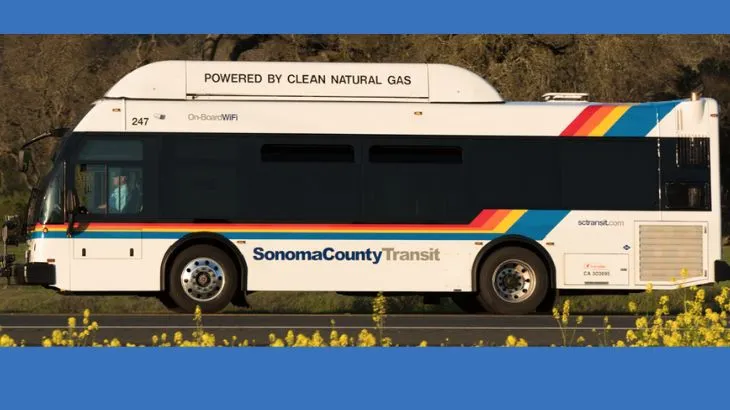 Image credit: Sonoma County
The Sonoma County Board of Supervisors approved the purchase of seven battery-electric buses (BEBs). With this purchase, Sonoma County Transit, a division under the Sonoma County Department of Public Infrastructure, will have approximately 49 percent of its 49-bus fleet electrically powered by the end of 2026.
The new buses have been ordered from Gillig, a Livermore-based manufacturer that has supplied at least 500 electric buses nationwide—20 percent of which have gone to California transit operators, including the Napa Valley Transit Authority and Solano County Transit.
The county will spend $8.75 million on the new buses, at a net cost of $1.25 million each. The purchase will be made using local, state and federal funding sources, including the Federal Transit Administration, the state’s Transit and Intercity Rail Capital Program, and local funds included in the county’s 2024-2025 fiscal year adopted budget.
Once they are delivered in November 2026, the seven new buses will be deployed on main intercity routes, which operate between Monte Rio, Santa Rosa and Sonoma (Routes 20 and 30) and between Petaluma, Santa Rosa and Cloverdale (Routes 44/48 and 60). The new buses will replace natural gas-powered buses in the current fleet that have exceeded the 12-year minimum service life required by the Federal Transit Administration.
Sonoma County Transit has been a leader in clean-fuel and low-emission buses since 1996 when it began transitioning from diesel power to natural gas power. Sonoma County Transit introduced its first all-electric bus in 2019 with the fare-free Sebastopol Shuttle (Route 24). Since then, an additional five 30-foot and three 35-foot coaches have been added for use on local routes in Healdsburg and the Rohnert Park-Cotati area (Route 42) and shorter intercity routes between Industry West Park and Downtown Santa Rosa, the Sonoma County Airport and the Windsor Depot (Route 62).
Under a California Air Resources Board requirement, all new buses purchased by public transit agencies after 2029 must be zero-emission vehicles. By 2040, the state aims to see all fossil-fueled buses retired.
In addition to the seven buses approved, Sonoma County Transit is awaiting the delivery of a 30-foot coach, two 35-foot coaches, and five 40-foot coaches, which are expected to arrive in September 2025.
The new buses have a minimum range of 240 miles between charges, depending on passenger loads, weather and other factors that impact an electric vehicle's range. Like the county's existing fleet, the new buses have features such as high-back reclining passenger seats, a video security system, onboard Wi-Fi, the NextBus passenger information system, and electronic fareboxes.
Source: Gillig