Metra orders battery-powered trainsets from Stadler, secures RVR grant
 Image credit: Metra
Metra Board of Directors have approved a contract to buy zero-emission, battery-powered trainsets. Metra will be one of the first in the nation to operate this innovative technology. The first sets are expected to be delivered in 2027-2028.
The contract with Stadler U.S., of Salt Lake City, Utah, includes a $154 million base order for eight two-car, battery-powered trainsets, including engineering, training, and spare parts, with options costing up to an additional $181.4 million for eight more trainsets and up to 32 trailer cars, which could be added to the two-car trainsets to create three- or four-car trainsets.
Metra received a $169.3 million federal Congestion Mitigation and Air Quality Improvement (CMAQ) grant for the trainset purchase, which will cover the base order and some of the options. Funds from the state PAYGO program will pay for the grant’s required local match of 20 percent.
Metra also received $100 million under the FY 2024/2025 & Partial Year 2026 Rail Vehicle Replacement Program Project to buy 50 modern, multi-level railcars that will feature new passenger safety, accessibility, and rider comfort amenities to replace older railcars that have been in service for more than 40 years.
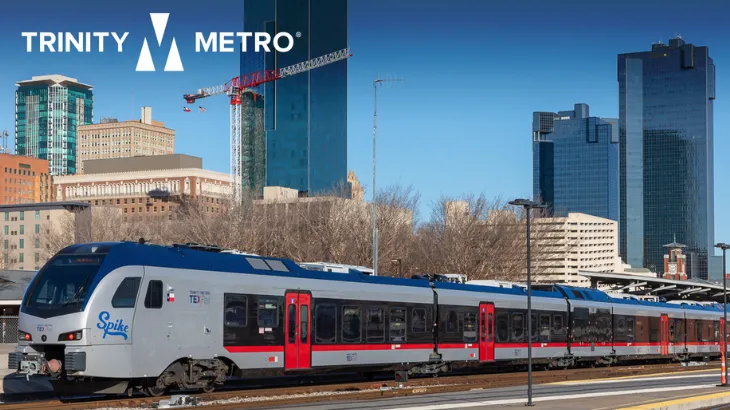
A trainset is a group of permanently or semi-permanently coupled railcars powered by a propulsion system without a separate locomotive, with operator controls at either end so they can quickly change directions. The trainsets will have low-level boarding and will be equipped with lifts to make them ADA-compliant. Each two-car set will seat 112 people, and each additional trailer car will provide seating for about 46 people. The single-level sets will have open gangways so riders can move freely from car to car. They will include such features as passenger information signs, bike racks, luggage racks and USB outlets. Half of the trailer cars, if purchased, would include ADA-accessible bathrooms.
The battery-powered trainsets could play a significant role in helping Metra achieve its vision to provide more frequent all-day service – so-called regional rail service. Metra plans to introduce the trainsets between LaSalle St. and Blue Island on the Beverly Branch of the Rock Island Line, a distance of 16.4 miles. That would directly benefit the air quality in economically disadvantaged neighborhoods on the South Side of Chicago.
A fully charged trainset is expected to have a range of 45 to 65 miles. Charging time will vary, but going from a 20 percent charge to 80 percent – enough for the trainset to operate – is expected to take about 20 to 30 minutes. The exact charging infrastructure and its cost is yet to be determined.
Source: Metra