Cleveland RTA advances West 25th Street MetroHealth Line BRT Project
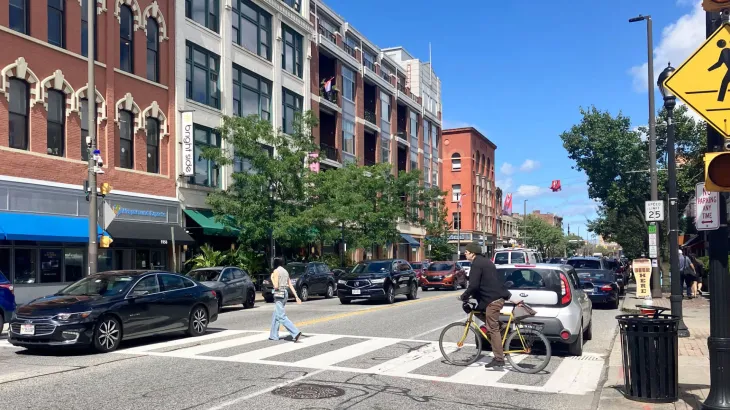 Image credit: Cleveland RTA
Greater Cleveland Regional Transit Authority (RTA) has planned conversion of West 25th Street to create bus-only lanes for a smoother public transit route with support of the mayor’s office, though concerns linger among some businesses worried about losing street parking. The West 25th Street route, known as the “MetroHealth Line,” would extend from the Detroit-Superior Bridge to Old Brooklyn - one of RTA’s busiest corridors.
Michael Schipper, RTA’s deputy general manager of engineering and project management, told RTA board members that he anticipated word within weeks from the federal government concerning the final piece of the funding puzzle. RTA is seeking a $20.4 million federal grant, which would cover more than one-third of the $52 million project. Even if RTA comes up short on this year’s round of federal funding, other options were possible to keep the project on schedule, Schipper said after the meeting. This is because more than half of the needed federal, state and local money has been secured.
Plans call for completing the design this winter, and making necessary street, sidewalk and station changes in 2027 and 2028 so the new bus rapid transit (BRT) route can open in late 2028. RTA said bus travel times through the area now vary, depending on congestion, from 15 to 29 minutes. The agency expects the BRT system to improve that to the 15- to 18-minute range.
The concerns raised by local business owners center around a short stretch of the project near the West Side Market. Business owners are opposed to the elimination of street parking for a few blocks north and south of Lorain Avenue. However, Schipper said that area is the key “pinch point,” accounting for about half the delays over the entire West 25th Street corridor. He said removing the bus-only lanes near the West Side Market would likely cause the project to score lower in RTA’s bid to receive competitive federal funding.
Schipper and Cleveland Planning Director Calley Mersmann outlined the project and the city’s efforts to address the loss of 55 street parking spaces near the West Side Market. RTA board members, who are appointed by the city, county and suburban mayors and city managers association, spoke positively of the project after hearing the update.
Mersmann said work was underway to create designated short-term and handicap parking on nearby side streets, and that the proper use of those spaces would be closely monitored - in part with a new camera system the city intends to implement to better police parking laws. Mersmann said that although there would be a net loss of 55 street parking spaces, studies show that even at peak times, only 70% of the area’s 1,956 available parking spaces are being used. Better warning lights and other safety improvements will be made to pedestrian crossings, she said.
Ohio City Inc., the nonprofit representing residents and businesses neighborhood-wide, will push for the city carry out its parking plan, Executive Director Jane Platten said. The organization had not taken a hardline against the bus lanes, but Platten said the project will lead to substantial changes.
Schipper said the design work is 90% complete. The only stretches without bus-only lanes are for short distances near the interchanges with Interstates 71 and 90, near Clark Avenue, where it was determined that a left-turn lane would do more to alleviate delays than the bus-only lane.
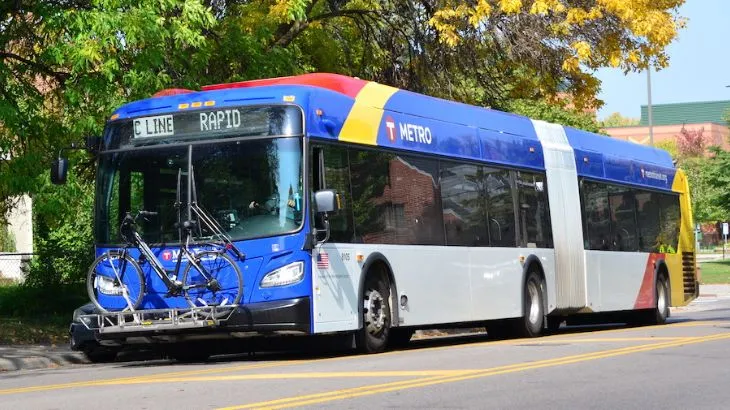
BRT was first introduced in Cleveland in 2008 on Euclid Avenue - the Health Line - as an alternative to what would have been far more expensive new rail service. The goal is to increase speed with fast-loading stations, stopping at fewer places than normal bus routes and incorporating bus-only lanes.
Source: Cleveland RTA