Building Buyer-Supplier Partnerships for Success
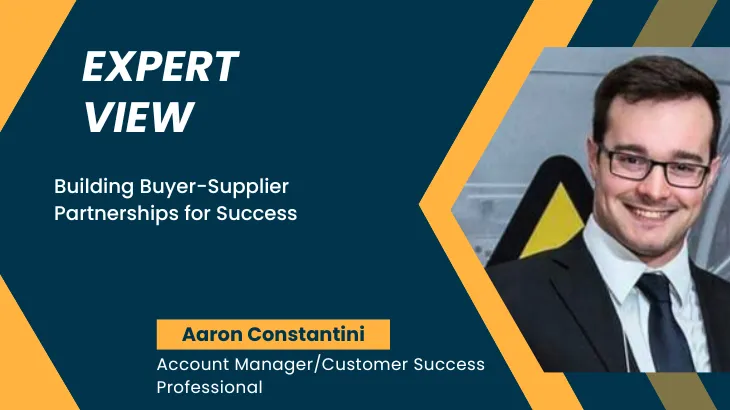 Image credit: TAM America
TAM America had the privilege of conducting interview with Aaron Constantini, Account Manager/Customer Success Professional, and is pleased to share his perspectives for the transit industry.
What has been your recent professional experience in Customer Success Management, Account Management, and/or Business Development?
My responsibilities at Seifert Graphics were centered primarily around prospecting for and establishing new clients. Secondarily, I was also the account manager for the clients that I did bring in. For me, personally, this was the highlight of my position. I find it incredibly rewarding knowing that clients know that they can come to me with something they need taken care of, and that they trust me to take care of it. So, one could say I wore a few different hats; Account Executive, Account Manager, and Customer Success Manager, all wrapped up into very unique role.
What are some of the challenges you faced in your role and how did you overcome them?
I certainly struggled - as I’m sure many salespeople do - finding potential clients to reach out to. More importantly, I struggled with “why am I calling so-and-so?” Which is to say, I always wanted to make sure that if I was calling someone for work, that I hadn’t spoken to before (or simply hadn’t made much progress with), that I had a reason for calling them.
Going back to my last response, without a reason to be reaching out to someone, it felt like I was merely trying to make a sale. Which is exactly the approach I tried very hard to avoid. And so I had to constantly ask myself: “Is there a good reason to reach out to this person?” And once I had one, I knew it was genuine, instead of money-focused.
These relationship-building strategies inevitably lead to sales happening anyway. The reality is, people want to work with people that can not only provide the products/services they require, but more importantly, that treat them like the human beings they are.
What strategies did you adopt to succeed in managing client expectations?
My job focused more around what my clients needed and ASAP was the name of the game. Often these types of decisions were either out of my hands or above my authority level. However, I would argue that everything comes down to communication. The ability to effectively communicate what one’s agency needs and then conversely, what the supplier needs, is crucial.
Often, I would run into projects where one side does their part, then the other does theirs, and so on, until at some point it hits a slow down. This slow down was usually related to one side simply not answering/responding. It sounds silly, but something as simple as not receiving an email or getting someone on the phone for two weeks, can slow down an entire operation.
That said, establishing up front, in very transparent terms what each side can expect from each other can make “slow down” situations much simpler, as both sides know that it’s to be expected. Again, communication and openness are the keys to success!
How can transit agencies and suppliers build partnerships that are long lasting and strategic?
Transit agencies, banks, media studios - it doesn’t matter what your business is. In the end there is one important rule to follow, in my opinion: be human. We’re all human, we’re all trying to do our best in our own ways. It’s easy, however, to get lost in the day-to-day of what we have going on. It’s easy to fall into the trap of numbers, or “this company, that company.” But we are not the companies we work for, to the same degree that we are not numbers. In other words, I believe in bridging the gap between being successful and being human.
I attribute the success I had at Seifert Graphics to a human approach with my clients. I knew people exclusively by their first name, I made sure to check in just to say hi - not for the purpose of making a sale - and to see how things were going. It’s important for people to understand that they are not simply a sales “$” to me. I believe that if you can approach business with that mindset, it comes across in your personality; in the way you communicate with people. And it’s a wonderful thing because those people you’re communicating with, they can tell you’re genuinely trying to help. And I think, in today’s world, that’s so much more valuable than we give it credit.
What is the most important lesson you have learned over your career?
I was always told that in business - and in life - that no one was going to do the things that I was doing. That “being kind is great, but it won’t get you anywhere in the real world. People will take advantage of you.”
I decided to try it anyway and see what happened. And as it turns out, it works just fine. Kindness is never a weakness; it’s simply a different approach to what we’re already doing. And if we’re already doing it, why not be nice about it?